|
Asbestos In New Zealand
------------------------------
Just before the Second World War
asbestos really only found its way
into New Zealand in the form of manufactured items.
Since that time,
the only asbestos containing products
that have been manufactured
in any quantity in this country
were asbestos cement building material,
such as roofing and wall claddings,
pipes and other moulded products.
Depending on the item being manufactured,
they were made of a mixture
of Portland cement,
sand and usually between
5 and 15 percent of either
chrysotile, amosite or crocidolite
the asbestos acting as reinforcing
because of it's fibrous nature
and its high tensile strength.
The bulk was the white variety,
chrysotile , which was cheaper
and more easily worked.
Because the;"best" blue
crocidolite from South Africa
was more expensive it tended
to be used in only products requiring
greater heat tolerance or strength
(such as in pipes expected to contain
higher pressures or temperatures).
A lesser quality of crocidolite
from the Wittenoom mine in
Western Australia
was also used to some extent.
Amosite, or brown asbestos was
imported from Rhodesia (now Zimbabwe).
Another major use of asbestos
was as the raw material for insulation
and acoustic products.
------------------------------
This saw the various types of
asbestos mixed with a binder
and spayed around boilers,
pipes, ducts and other places where
insulation against heat and noise was needed.
From the 1950's until the 1970's
thousands of tonnes of
asbestos were applied in this way,
most notably in the power stations
built in the period,
but also in railway workshops,
shipbuilding and maintenance
and other large scale industrial applications.
Sprayed asbestos was also extensively
used as a fire retardant
for protecting structural steelwork.
Usually the insulation was applied by contractors
who mixed asbestos from the bags
or sacks it had been imported in,
before spraying the mixture on to
chicken wire reinforcing.
Other work places where asbestos
was used included railway workshops,
boiler rooms, and in fact most of the
countries major industrial complexes
where insulation against heat was required.
------------------------------
Some of the industrial applications were less obvious.
For example, asbestos was commonly
used in the brewing industry
to filter beer from the 1920's
to the early 1970's,
and it was dropped into wine
to act as finings and to clarify
the finished product.
Another unusual use for
blue asbestos was as a
filtering component in gas masks
of British Manufacture that were
standard issue for troops
and others from the First World War
until after the Second World War.
An inner core of asbestos was
surrounded by woollen wadding
and the item was standard issue
to all New Zealand Troops
in danger of gas attack.
------------------------------
Before the Second World War,
asbestos was not imported in its raw state
in sufficient quantity to appear
in the import statistics.
With the beginning of local manufacturing
and an increase in post war construction,
more than 2000 tonnes were being imported
annually by the late 1940's.
This continued though out the 1950's
with peaks of up to 5000 tonnes
in some years.
Usage increased dramatically during the 1960's
and until well into the 1970's
with the 5000 tonnes being a
minimum amount being imported
during those years,
and the average being
closer to 8000 tonnes.
Imported asbestos peaked in 1975
at 12,500 tonnes though
as recently as 1983, 3000 tonnes were imported.
Through out the 40 years
asbestos was imported in large quantities,
about two thirds of the amount
imported was chrysotile from Canada,
with the balance being made up of
different types from Australia,
South Africa or,
to a lesser extent, the United States.
Asbestos was only ever mined
in small quantities in New Zealand,
as chrysotile from a single mine near Takaka
from the early 1950's
until early 1960's.
It was of low quality and had
to be mixed with imported material.
In the late 1960's a sizable deposit
was found near Dusky Sound,
but for various reasons
these were never exploited.
Since 1984 the importing of
Blue and Brown asbestos
has been banned
(in its raw state?)
Permission for the above information was kindly allowed
by Capital Environmental Services (2005)Ltd
-----------------------------
Deadly building materials still coming into NZ
report NZPA | Tuesday July 1 2008:
Building products with asbestos in them
are putting builders at deadly risk,
a new report commissioned by the
Department of Labour says.
The report, obtained by NZPA under the
Official Information Act,
says many builders
would not know asbestos if they saw it.
And while local manufacturing of those products
ceased in the late 1980s,
builders might also be at risk of
imported goods from countries
where there is no such ban.
New Zealand has a ban on importing
raw asbestos but no ban
on importing asbestos in goods
as long as they are labelled,
and no testing for them at ports.
------------------------
The report's author is
former national operations manager
for Occupational Safety and Health,
Mike Cosman.
Now a consultant,
Mr Cosman said he knew of several unlabelled
imported products in recent months
that had tested positive for asbestos.
They included roofing materials,
flooring and even tape.
But he said there was no way
of knowing how much was coming
into the country at the moment.
Much of it is from southeast Asia,
where there are no constraints
on manufacturing with asbestos.
"There is little rationale
for not introducing a ban as
safer alternatives are available
for the vast majority of uses."
New Zealand factories stopped making building,
products containing asbestos
in the mid-1980s after the fibre
became clearly linked with respiratory illnesses
and cancer.
Asbestos is deemed safe if intact.
But builders and home renovators
are still vulnerable to exposure
if they unknowingly disturb old housing materials
with asbestos in them.
Mr Cosman's report also found
low awareness of asbestos
in the construction industry.
"The older workers tended to think asbestos
was yesterday's problem,
that it had all been sorted in the 80s,
and younger workers,
of which there were an increasingly number
in the industry,
know nothing about it."
The Department of Labour said it was
carrying out a wider review
of asbestos handling in the workplace,
which might include a ban
on imported asbestos products.
In late April,
a cancer researcher said he believed
one in 10 Australian carpenters born
before 1950 would die of a fatal
asbestos-linked cancer, mesothelioma.
Professor Julian Peto said the use of
brown asbestos or amosite,
and blue asbestos or crocidolite,
in building products in Australia
and Britain until the 1980s
had been completely uncontrolled.
"Carpenters would chop it up with power saws
without much concern at all."
The Australian Council of Trade Unions
has called for a national inquiry
to examine ways of eliminating asbestos
from workplaces and homes.
------------------------------
January 2011.
I have inserted my own
comments during this page,
so anything in italics is from me.
Products containing asbestos
are still allowed to come into New Zealand
with absolutely no HSNO approval
from ERMA being required.
There is no comprehensive list of
the products that contain asbestos
that may currently be imported into
New Zealand
I believe most New Zealanders
who know how dangerous
asbestos is,
also believe that when the
import of raw asbestos was banned in NZ
it really meant any asbestos coming into NZ.
and did not realise that raw products meant just that.
(Who was to know that
somewhere down the line
some one with no brain whatsoever
was going to come along and say
"No problem.
It's quite safe,
No need to worry
I'll be long dead
before they find
out I was wrong"
IDIOTS!IDIOTS!
THAT'S WHAT WE ARE
AND THE SAD THING ABOUT IT,
IS WE JUST NEVER LEARN.
------------------------------
HOW CAN THIS BE TRUE?.
THERE IS A PROVISION TO OBTAIN
AN APPROVAL from ERMA
The Hazardous Substances
and New Organisms Act 1996
requires anyone wishing to import raw asbestos
to first obtain an approval
from Environmental Risk Management Authority (ERMA).
Prohibited imports
The following schedule sets out a brief explanation
of the import prohibitions
and restrictions that the
New Zealand Customs Service
enforces at the border.
Controls on the Importation of Hazardous Substances
Asbestos in its raw fibrous state
Hazardous substances
including explosives,
and certain toxic substances.
Purpose
Control the importation of
asbestos in its raw fibrous state
Controls on the Importation of
Hazardous Substances.
Environmental Risk Management
Authority Legislation:
Hazardous Substances
and New Organisms Act 1996.
------------------------------
1999
CUSTOMS IMPORT PROHIBITION
ASBESTOS) ORDER 1999 023
Commenced: 4-MAR-1999
EXPLANATORY
NOTE.
This note is not part of the order,
but is intended to indicate its general effect
This order continues the prohibition on the importation
of asbestos into New Zealand imposed in 1984.
There are 2 changes from the 1984 order.
First, chrysotile, in its raw fibrous state,
has been added to the list of prohibited imports.
Second, the Minister for Enterprise and Commerce
has replaced the Minister of Health as the Minister
who may give consent to the importation of asbestos
and who may impose conditions on the importation.
Issued under the authority of the
Acts and Regulations Publication Act
1989 Date of notification in Gazette:
4 February 1999.
This order is administered in the
New Zealand Customs Service.
------------------------------
Briane Smith (MIN)
Wed 09/09/2009
On behalf of the Prime Minister,
Hon. John Key,
thank you for your email of 1 August
and your subsequent emails of
10th, 14th, and 22nd August 2009.
I regret the time that it
has taken for me to respond.
As the issue you have raised
falls within the portfolio responsibilities
of the Minister for the Environment,
I have forwarded your email
on to the office of Hon
Dr Nick Smith for his consideration.
Thank you for taking the time
to write to Mr Key.
Regards, Briane Smith.
PRIVATE SECRETARY,
Office of the Prime Minister.
-------------------------
Briane Smith (MIN)
Sent: Friday, 16 October 2009
Subject: Re: RE: Thank you for your email,
On behalf of the Prime Minister, Hon John Key,
I acknowledge your email.
Your comments on the Governments decision
to deploy the New Zealand SAS to
Afghanistan have been noted.
Thank you for taking the time to write to
the Prime Minister and for sharing your concerns.
Regards Briane Smith
Private Secretary, Office of the Prime Minister
From: Deidre van Gerven
Sent to, 16th October 200: Briane Smith (MIN)
RE: RE: Thank you for your email
I'm not sure what message you think you
received from me but it certainly
was nothing to do with sending troops to Afghanistan.
Obviously you have a mix-up of sorts.
My comments were about banning all products
coming into NZ that contain Asbestos.
I also included my website for you to look at.
If any one had taken the time to read the mail
that is sent to your premises they would have known
what I was talking about.
This was your previous answer to my first letters
It was quite a time after I got this reply from you
that I heard the staff of Nick Smith.
And of course they were putting it on their
urgent list to be looked at.
I wouldn't like to be on their urgent list
if a tsunamei was on its way
Many thanks from Deidre
------------
22nd OCT 2009
Office of Hon.
Dr. Nick Smith.
MP for Nelson
Minister for the Environment
Minister for Climate Change Issues
Minister for ACC
Dear Deidre vanGerven,
Thank you for your email of 1 August 2009
to the Prime Minister regarding
health risks from asbestos.
I am responding on behalf of the Prime Minister
as the issues you raise touch on a
number of Ministers' portfolios.
I am sorry to hear of your
distressing first hand experiences
and I agree with you that managing
the potential effects of asbestos is important.
I can assure you that both the mining of asbestos
in New Zealand and the import
of any form of raw asbestos
fibre into New Zealand has,
for all practical purposes,
been prohibited.
New Zealand factories
stopped making building products
containing asbestos back in the 1980s.
The focus now is ensuring
the appropriate management
and handling of historic asbestos products
that are still in use or have been disposed of.
This is mainly achieved through the
Department of Labour
(which manages asbestos in places of work)
and through local authorities,
who manage landfills and other sites
where asbestos has been disposed of.
Further, although some products
containing asbestos are still able to be imported,
suppliers of products containing asbestos must
ensure that the products are labelled as such,
so that adequate precautions may be taken.
As the use of asbestos-containing products
is decreasing internationally,
the government does not consider that
further regulation of imports
is required at this stage.
The Department of Labour is the department
that manages the potential risks from asbestos,
through the Health and Safety in Employment
(Asbestos) Regulations 1998
and the Guidelines for
the Management and Removal of Asbestos.
I suggest that you contact them
directly with any further concerns.

On Dr Nick Smith,
"Minister for the Environment"
-----------------------------
A lot of imports are coming
from countries that have little or no regulations
on the use of asbestos
Do you really believe that a country
is going to put labels on goods saying
there is asbestos in their products,
when they don't have any rules and regulations
for the safety of their own workers,
Come of it.
That's called "Putting you head in the sand"
I bet there is no one taking regular samples
of these products and testing them for asbestos
The only way you can police this sort of trade
is a total ban on any asbestos,
in any form being allowed into New Zealand
Regular testing of products from the countries
that do not have any appropriate regulations
set up on the control
and use of asbestos in any form.
-----------------------------
The following letter was sent by me
Deidre vanGerven
Sent: Thursday, 22 October, 2009.
Subject: Emailing:
Thank you for your reply to my letter.
I hear you say that you are sorry to hear of my
distressing first hand experiences of this product.
But unless you have gone through it yourself
you cannot imagine
what it was like for me,
my family, my husband's family
and all those people that have either already died
from this product or in the near future will do so.
It is bad enough that
the products that were made
with or from asbestos are still in existence
and will most likely be forever in our environment,
but to knowingly still allow products to
be bought into NZ is criminal. There are no excuses.
Surely the Minister for the Environment
should be doing something about the law
to change this from happening. Or, as usual the game of
" pass the buck"
still happens.
It's easier to say
"it is not their responsibility."
The sad thing is if they
say it long enough
they will actually start to believe it.
Of course it is their responsibility.
Why do they think they were put in their positions.
If they can't do the job they were given, then
I believe they should stand down and give it to
someone else who morally thinks
the existing laws are wrong.
Does this minister really think that people
read labels on products to see if they have asbestos in them.
Most people believe that
because the import of raw products
have been to all practical purposes prohibited;
the normal person in NZ
believes that means all asbestos products.
Not just the raw product.
1. In your second paragraph
you say that
the import of any form
of raw asbestos fibre into NZ has,
for all practical purposes,
been prohibited.
So when you say;"for all practical purposes"
are you saying that some of this raw product is
still being imported for impractical purposes.
2.What products that contain asbestos are
still being allowed into NZ.
I WOULD LIKE TO BE GIVEN A LIST OF THESE
TO ADD TO MY WEB SITE.
3.The use of asbestos is not really decreasing.
It is still being sent to countries where
the bulk of the people are not educated enough
to be aware of what is being done to them by unscrupulous countries.
As far as the Department of Labour being involved
in the safety issue.
That has nothing to do with the problems
I am asking about.
They are not the people responsible for the change of laws.
That is the responsibility of the Members of Parliament
who are paid by the people of New Zealand
to do their job and do it properly.
So far I do not see any evidence of this happening
.I believe it is still your business
to do something about this.
The word Honourable placed before a name of anyone
needs to be deserved in my opinion.
I have seen no evidence to do so
for any person who allows this to be happening,
yours sincerely,
Deidre vanGerven
-----------------------------
Office of Hon.
Dr.Nick Smith.
MP for Nelson
Minister for the Environment
Minister for Climate Change Issues
Minister for ACC
Thank you for your email of 22 October 2009
regarding the use of asbestos in New Zealand.
In your email you query the importation
of raw asbestos and request a list of the products
that contain asbestos that may be
imported into New Zealand.
The Hazardous Substances and New Organisms Act 1996
requires anyone wishing to import raw asbestos
to first obtain an approval
from Environmental Risk Management Authority (ERMA).
No-one has applied for an approval to
import raw asbestos.
The fact that no one has applied for an approval
to import raw asbestos is neither here nor there.
There should be no option for them
to even think about importing it into New Zealand.
Should anyone do so,
they would have to undertake a full assessment
and convince ERMA that the positive
effects of importing raw asbestos
outweigh the adverse effects.
Hence my earlier comment that the
importation of raw asbestos has,
for all practical purposes,
been prohibited.
The situation with asbestos-containing
products is different.
No HSNO approval from ERMA is required
------------------------------
Either it is banned or it is not banned
If it is banned then
there should be no provision
to allow it to be imported into New Zealand
for any reason."
(NONE WHATSOVER. !!!!)
YOU CANNOT HAVE IT BOTH WAYS.!!!!
-----------------------------
However, these products are usually
used in a work situation where the
provisions of the Health and Safety in Employment Act 1992 apply.
In some cases,
their use is necessary because alternative
products are not available.
There is no comprehensive list
of the products that contain asbestos
that may currently be imported into New Zealand. However,
I can advise that the types of products
that may contain asbestos are cement sheets,
friction materials and articles
such as clutch pads and gaskets.
The government continues to support
international efforts to control the production
and export of asbestos,
including placing chrysotile under the Rotterdam Convention
-----------------------------
How can they be supporting anything
when they are still allowing these products
to come into New Zealand !!!
So obviously,
it's okay to import but not to export
Some one is finding it hard to understand the words.
"ASBESTOS IN ANY FORM CAN KILL YOU.
AND DEAD MEANS DEAD.
WHETHER IT'S THE RAW PRODUCT,
OR BEING CONTAINED IN A PRODUCT
I hope this Minister of the Environment
is not thinking of removing
any asbestos related claims from ACC.
After all he is also the Minister of ACC
And this Government
thinks too much is being spent on ACC claims
Is he is going to stand up and be counted,
for allowing these products
containing asbestos to
still be imported into New Zealand,
which is only going to prolong the incidences of
asbestos related diseases here.
Or is he going to put more money into ACC
to help those poor victims to die,
knowing their families will be taken care of.
Nobody can use the excuse any more
that they did not know that
exposure to asbestos is dangerous.
There's got to be something
terribly wrong with how they think
if they do.
----------------------------
However, as I noted in my previous response,
the government does not consider that further
regulation of imports of asbestos-containing products
into New Zealand is required at this stage
Yours sincerely
Hon Dr Nick Smith
Minister for the Environment
---------------------------------
No, of course not.
That might involve doing some work,
HOW TIRING !!!
----------------------
Thu 17/03/2011.
[email protected]
Noel McCardle
[[email protected]]
Dear Mrs van Gerven,
Your concerns regarding the importation
of asbestos in its raw form,
have been passed on to me for a response.
There is not a lot I can add to the
advice given to you by the Minister for
the Environment and Margaret Keane;
however, I would advise that the
importation of asbestos,
in its raw form,
is not approved under the HSNO Act
and anyone doing so could
face prosecution from our
enforcement agency
the Department of Labour.
In addition,
the Customs Department would
not allow asbestos,
in its raw form,
to cross our borders without
a HSNO approval.
With respect to asbestos contained
in manufactured articles,
such as brake pads,
importation of these items is not
within the purview of the HSNO Act.
Accordingly, I suggest you approach
the Ministry of Consumer Affairs
for further information on such importations.
I hope this clarifies and answers
any concerns you may have.
kind regards, Noel McCardle
------------------------------
See, !!!! even he says that 'in its raw form,'
to cross our borders without a HSNO approval .
so to my way of thinking it is not
completely banned in it's raw state.
If it was, then there would be no
provision whatsoever for it to be
allowed to come into NZ.
"None whatsoever"
-----------------
Asbestos in Automobiles
For many decades,
asbestos has been used by the automotive industry
in brake pads and linings,
clutch facings, and gaskets.
Millions of these products still remain
on vehicles currently in use today,
which poses a severe risk of
asbestos exposure to current and former
auto mechanics across the country.
Breathing in asbestos dust
can lead to asbestosis,
lung cancer, and pleural mesothelioma,
an aggressive and painful
cancer that attacks the lining of the lungs.
Mechanics do not develop these diseases
until 15 to 50 years after their
initial exposure to asbestos,
so they may not realize the extent of
the damage to their health.
They may also have the mistaken concept
that asbestos has been banned.
Millions of cars and trucks still have
asbestos-containing brakes and clutches,
which were routinely used in older vehicles.
Also, imports of asbestos
brakes have increased 83 percent over the past decade.
And while it may come as a shock to most people,
some brakes and clutches in production today
are, in fact, still made with asbestos,
just in smaller quantities than older brakes.
When asbestos-containing materials
are disturbed or damaged,
they release a dust filled with microscopic
asbestos fibers into the air.
As a result, the very nature of brake
and clutch functions causes continual abrasion,
and this releases the imbedded asbestos fibers.
A large portion of the toxic material
is trapped inside the brake housing
or clutch space,
and is then released when replacement
or repair work is performed.
Asbestos fibers can be further spread
into the surrounding air
by the vacuums used to clean the work area
during and after the job.
The fibers tend to linger in the air
long after a job is done and can
spread 75 feet from the work area,
thus potentially exposing other mechanics
and even customers who enter the shop.
Airborne asbestos fibers are easily inhaled
and can even be ingested if fibers
get on hands and clothes.
This is a particularly difficult problem
for mechanics, since they often get grease
on their hands and asbestos fibers
can stick to the grease.
Tragically, asbestos can even be carried home
on workers' clothing, exposing their
families to the hazardous material
Hoodliners - Over the past few decades,
millions of vehicles have been
manufactured with automotive hoodliners
constructed from asbestos fibers.
While asbestos is remarkably fire-resistant,
it is also the leading cause of mesothelioma
, an extremely deadly form of cancer.
Brakes - During normal automobile use,
asbestos brake linings wear
down through friction,
releasing asbestos dust just
as sanding wood creates sawdust.
Much of this asbestos dust is trapped
in the brake housing.
When the brake housing is opened,
that dust is released into the air
where workers can inhale it or ingest it.
Clutches - Some clutch parts in use today
both in new and older cars
contain asbestos.
During normal wear,
the asbestos is ground down
and may collect around the parts
and in clutch compartments.
When the disk, clutch cover,
drum or wheel is removed,
that dust may be released into
the air where it can be inhaled or swallowed.
Gasket Material, Heat Seals, Valve Rings and Packing -
For decades, asbestos-containing gaskets,
heat seal material, valve rings,
and packing were used in virtually
every system that involved the transport
of fluids or gases.
Prior to the mid-1970s,
some automobile exhaust systems
contained asbestos gaskets either
at flanges along the exhaust pipes
or at the exhaust manifolds
of the engine.
Hazardous Cleaning Techniques
The Occupational Safety and Health Administration (OSHA)
advisory instructs mechanics to assume
that all brakes contain asbestos
because a mere visual inspection does not
indicate which brakes include
asbestos and which do not.
The following brake cleaning techniques
can result in the release of asbestos
into the air and consequently
may lead to employee exposure:
1. Using a shop vacuum cleaner -
a shop vacuum filter is not fine enough
to collect asbestos fibers
2. Using a compressed air hose
to clean drum breaks
3. Wiping with a dry rag or brushing dust from the assembly
4. Wiping with a wet rag or brush -
a wet rag will still scatter
asbestos fibers
(furthermore,
once it dries,
the fibers can still spread around
the work area)
5. Using liquid squirt bottles or solvent sprays
6. Using a water hose
-------------------------------------
United States Occupational Safety and Health
Administration (OSHA)
---------------------------
Nonprofessional and home auto mechanics
that repair or replace their own
brakes or clutches are also
in danger of exposure to asbestos
and asbestos related illnesses.
Rarely do people working on cars at their home
take the proper precautions
to prevent fibers from entering the home,
which also poses a great risk to
their families and pets.
Many experts believe that exposure at home
can be even more severe,
as many auto enthusiasts are not
in possession of tools used
by most shops to make the jobs
quicker and easier.
This can lead to actions that further
disturb asbestos,
including repetitive strikes with
a hammer to release the older product.
Deaths Expected to Rise
It is estimated that more than
six million mechanics have been exposed
to asbestos in brakes since 1940,
and those exposures are now resulting
in about 580 excess asbestos-related
cancer deaths a year.
Many analysts also believe that over
the next 10 years,
the expected rate of mesothelioma deaths
as a result of exposure to break dust
will reach 200 a year,
acknowledging that for every mesothelioma case
diagnosed there may be dozens of
cases of asbestosis.
Deaths caused by exposure
to asbestos brake products had been
previously expected to peak around the year 2012,
however, because asbestos is still
in some brakes being sold today,
it could mean the deaths would
continue to climb.
-------------------------
And though those figures do
not sound excessive
They will, when you are told
that you have now become one of those statistics
And remember,
these are some of the products
coming into NZ,
with no checks being done.
---------------------
NEW ZEALANDERS TRYING TO
SNEAK PRODUCTS CONTAINING ASBESTOS
INTO AUSTRALIA.
What next ?,
Safety and Health Alert March 2010
Asbestos gaskets in imported plant Incident
Items of plant were recently imported
into Western Australia
and found to contain bonded asbestos gaskets.
The plant was imported from New Zealand and Thailand
for installation at a major industrial site.
Workers at the site were unaware
that any gaskets contained asbestos..
Contributing Factors
1. All forms of asbestos containing materials have been
prohibited imports in Australia since 31st December 2003
2. Gaskets containing asbestos are still manufactured in
some other countries.
3. Plant was imported that included temporary shipping gaskets
----------------------------
It makes me feel ashamed
that our country stoops this low.
I have not been able to find any more
information on this subject,
but I hope both offenders were heavily fined
As far back as I have been able to research
it appears to me
that asbestos is the greedy mans treasure.
The profit that has been made from this
deadly material is astronomical.
And if you also add the deaths world wide
the figures go through the roof.
I hope those responsible
for these figures have accepted
what they have done.
Once it was known of the dangers
to mankind that asbestos caused,
then to proceed with the manufacture
and sale of this product
is tantamount to murder.
-----------------------------
Updating This Page.
12th January 2013
Because we now have a new Minister of the Environment
Amy Adams, I thought I should write to her
to find out what she intends to do about these products
coming into New Zealand.
I wrote three times before the beginning of December, 2012
This is what I said the last time I wrote to her.
Amy, I wrote to you twice in the last two months
and you have never bothered to answer.
I was asking you as the Minister of Environment
if you were going to do anything about the law
that is allowing products with asbestos to come into NZ.
These include brake pads, clutch pads , cement products
and so many others that Nick Smith
could not even give me a list of them.
See my website to find out just what is happening
in NZ about asbestos.
fibreaware.org.nz.
Australia has had a total ban of products containing asbestos
since 2003
and will not even allow ships into their ports that contain asbestos.
What are you going to do about it?
Before you go off and have your Xmas with family,
just remember the families
whose loved ones are not sharing with them
because of this deadly product.
I suppose this will be going to be a "wait and see" period.
15th January, 2013.
Today I received an email from Robyn Tiller
who has said that consideration is being given
to my question and they will contact me soon.
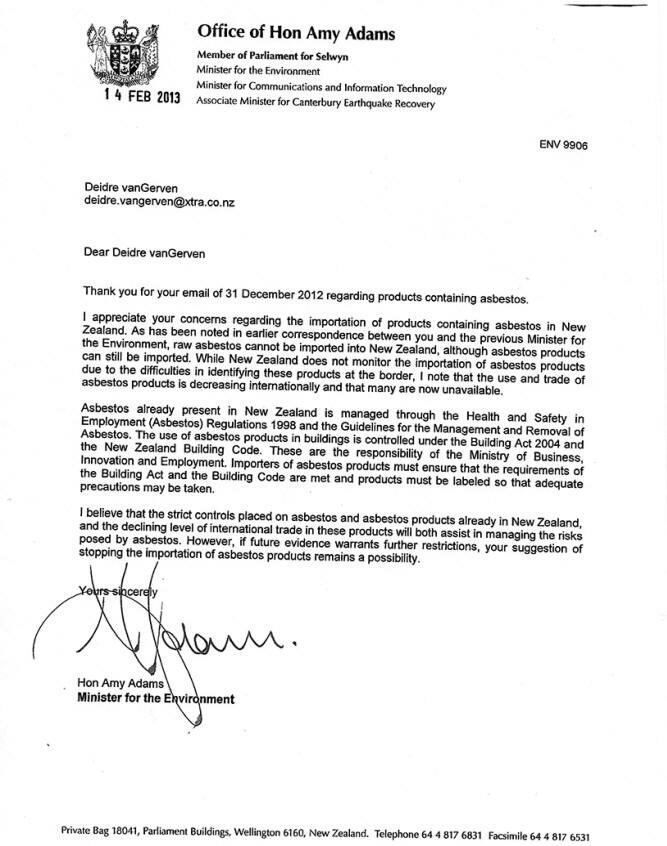
Dear Ms van Gerven
Please find attached a response from
Hon Amy Adams to your recent correspondence.
Kind regards
Robyn Tiller
Private Secretary
Office of Hon Amy Adams
Minister for the Environment :
Minister for Communications and Information Technology :
Associate Minister for Canterbury Earthquake Recovery
This sounded promising so I shall wait patiently till I receive an answer.
Deidre
------------------------------
_________________________
From: Deidre van Gerven
Sent: Sunday, February 17,
To: Robyn Tiller (MIN)
Subject: Re: From Hon Amy Adams
Dear Amy Adams,
thank you for your reply but once again,
I feel that "passing the buck" is in action.
You say in your letter that;
1. While NZ does not monitor the importation
of asbestos products due to the difficulties
in identifying these products at the border.
2. The use and trade of asbestos products is
decreasing internationally and that many
are now unavailable.
3. The use of asbestos products in buildings
is controlled under the Building Act 2004
and the NZ Building Code
4. I believe that the strict controls on asbestos
and asbestos products already in NZ,
and the declining levels of international
trade in these products will both assist
in managing the risks posed by asbestos.
---------------
Now lets go over all these points.
1. While NZ does not monitor the importation
of asbestos products due to the
difficulties in identifying these
products at the border !!!
And yet further on you say that
'The use of asbestos products in buildings
is controlled under the Building Act 2004
and the NZ Building Code'
How come they managed to identify those products.
Australia has banned all products containing
asbestos
from entering the country.
They, and many other countries have.
BUT NOT NZ.
Does not this suggest something to you.
As I have continually said.
'PASSING THE BUCK'
seems to go down well with
the existing member of Parliament.
2.The use and trade of asbestos products is
decreasing internationally and that
many are now unavailable.
This is not completely true.
Remember I told you that many countries
round the world still use asbestos
in their products, and have no regulations whatsoever,
and do not see any reason
to label their products.
Unless you have a specific agreement
with them about the non use of asbestos
and labelling (if it is in their product,)
then it will be coming into NZ.
And even if you do have an agreement
with them, you obviously keep
needing to do checks and tests
on products coming in.
-------
Look what happened in Australia.
Thank God for their strict regulations.
---------
Some mistakes are understandable.
Others seem to defy explanation.
Earlier this week,
two leading Chinese car companies,
Great Wall Motor and Chery Automobile
confirmed they are recalling 23,000 cars
and trucks they've sold in Australia
because asbestos was discovered in their
engine and exhaust gaskets.
According to a report by Bloomberg,
Great Wall and Chery had signed letters
to their distributor in Australia,
Ateco, guaranteeing that the vehicles
were asbestos-free.
Further and this is where things gets strange
representatives from Great Wall said
that they had conducted their own in-house
testing and concluded that the asbestos
was not a danger to "human bodies."
Chery, for its part,
offered the implausible excuse that
cars meant for the domestic market
(China does not ban asbestos)
were "accidentally" shipped to Australia.
If not an innocent mistake,
what else could be the cause?
The most likely culprit is a China
manufacturing phenomenon,
vividly described in the book
Poorly Made in China,
known as "quality fade."
Companies deliver initial product samples
that pass inspection tests with flying colours.
In time, however, the quality begins to
deteriorate as the manufacturer
often under pressure to preserve profits
introduces cheaper or non-standard product materials.
The more the material is hidden from plain view,
the more likely it is to be replaced
Result:
Yesterday's good-looking high-quality sample
fades into today's good-looking-but-flawed offering.
-------------
3.The use of asbestos products in buildings
is controlled under the Building Act 2004
and the NZ Building Code
I've spent almost 4 hours trying to find this.
Could you please send me a copy of the exact wording.
4. I believe that the strict controls on asbestos
and asbestos products already in NZ,
and the declining levels of international trade
in these products will both assist
in managing the risks posed by asbestos.
Asbestos in the raw state was banned.
I know that but I cannot find any controls
written about asbestos products in NZ
or the import of more of them into NZ.
Please can you send me a copy
of the part that says this.
The declining levels of
international trade in these products
is only by the countries that have
complete bans on such products.
We don't.
So there won't be any declining levels
here in NZ until your Government
does something about it.
Not just 'passing the buck' or
'putting your head in the sand
and ignoring the problem.'
but actually doing something.
Then you tell me who the responsibility
for this problem lies with.
The Ministry of Business,
Innovation and Employment (MBIE).
Well how many people am I expected to write to
considering the fact that it now covers four
separate government agencies.
And how long will it take,
going through all four ministries
(while they also 'pass the buck')
before I get an answer.
So I decided that perhaps because
you know them all you might pass this on
to the most appropriate minister
(at the same time letting him know
how long it has taken so far
for me to receive an answer)
This would be greatly appreciated,
regards from Deidre vanGerven.
-------
Formation of the Ministry
The Ministry of Business,
Innovation and Employment (MBIE)
was formed on 1 July 2012,
bringing together four separate
government agencies into one ministry.
These agencies were:
Department of Building and Housing
Ministry of Economic Development
Department of Labour
Ministry of Science and Innovation
------
I cannot fathom what these strict controls are.
How can she say in the first paragraph
"that NZ does 'not' monitor
the importation of asbestos products
due to the difficulty in identifying
these products at the border"
and then say in the second paragraph
"that importers of asbestos products
must ensure that the requirements are met
and products must be labelled
so that adequate precautions may be taken,"
That's a load of rubbish
as far as I'm concerned.
If a product has asbestos in it
regardless what it is used for,
it should be labelled as such.
________________________
___________________________
My Reply
April 2013
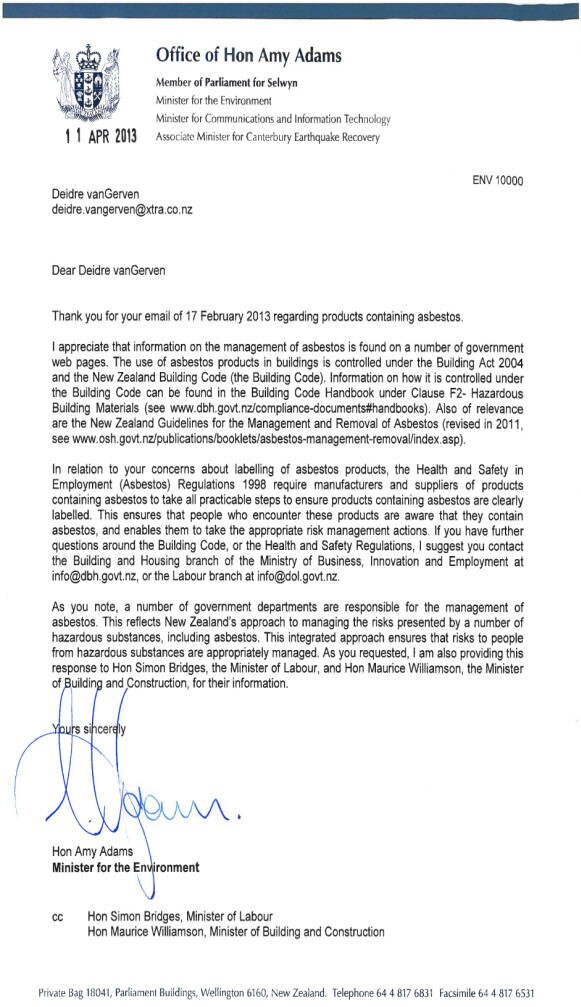
Dear Amy Adams
Re/ letter dated 11th April 2013
F2
Hazardous Agents On Site.
F2.1
The objective stated here is to safeguard people
from injury and illness caused by
exposure to hazardous building materials.
My view is "
why use a product which over the centuries causes millions of deaths."
(The World Health Organization estimates that 107,000 people
worldwide die of asbestos-related diseases each year.)
I cannot understand how anyone can believe
it is okay to allow products containing asbestos
to be used here in NZ when the Clause F2 states
it is to safeguard people from injury and illnesses.
Honestly, it does not make sense
to have a building code that says this
and yet you say it's okay for them
to use these products containing asbestos.
F2 .2. Buildings shall be constructed to avoid the likelihood
of people within the building being adversely affected
by hazardous agents or contaminants.
---------
Can you people not understand the words
"Asbestos kills".
What can be more hazardous than using this product
when there are other safe products that can be used.
I do not see anywhere that states
that builders should be using breathing gear when cutting,
nailing and screwing into these products,
while going about their job.
And what about the tradesmen who come in
over the years to do repair jobs.
Or even the householders
who do work on their homes.
And of course you need to look at our lovely country
that every now and again surprises us
and decides to send us an earthquake.
These lovely safe homes
built with products containing asbestos
become damaged and fibres begin to escape.
Plasterboard will be used to encase
potentially deadly asbestos in more than
4000 earthquake-damaged Christchurch homes
due for repair. Canterbury District Health Board
medical officer of health
Alistair Humphrey says the Earthquake Commission (EQC)
decision not to remove the asbestos
creates a "landmine".
Christchurch-based Labour MP Ruth Dyson,
in a statement on Wednesday,
said the asbestos looked set to create
a potentially fatal legacy,
akin to the trail of events which culminated
in the huge loss of life with the CTV building collapse.
Leaving asbestos in houses
contravened EQC's own guidelines, she said.
But of course if this happens it will be
"covered up"
just like it is down in Christchurch.
It is more expensive to remove asbestos
than to leave it where it is and cover it up.
But why go on perpetuating this problem.
In your position along with the Minister of Health
you should be changing the laws to make sure this
"STOPS, HERE AND NOW"
There really is something wrong
with the mentality of people
who find it is easier to hide
behind a few legalities
than to "stand up and be counted"
F2.3.3 (a),(b),and (c).
These products are cut into,
sawed into and broken while being used,
and also over the years
when home repairs are to be done.
The same things apply to Clause F1
that you have mentioned in the letter above.
In your third paragraph you stated
that a number of government departments
are responsible for the management of asbestos.
This integrated approach ensures
that risks to people from hazardous substances
are appropriately managed .
"What a load of rubbish"
What it really means is
there are more ways to hide
the inefficiency of a group of people
who are supposed to be protecting
New Zealanders and who are literally
doing nothing but
"passing the buck," once more.
Can’t you see that nothing is being done
at all about this matter.
I hate to say it,
but you really need to open your eyes
and see the truth of the matter.
I do not intend to write to the other ministers.
If you want to pass this on
and they feel the need to
come up with more excuses then
they have the right to do this.
Even if they are wrong in
what they are allowing to happen,
regards from Deidre vanGerven,
--------------------
Subject: An Open Letter to Christchurch and
New Zealand Authorities
Date: Friday, 2nd Aug 2013
On the 30th July 2013,
I sent a copy of this letter to every MP in
NZ hoping that someone will do something about it.
An Open Letter to Christchurch
and New Zealand Authorities
by Deidre van Gerven
Lord knows we have waited long enough for
the rebuilding of Christchurch.
In the eighteen months since the
earthquake devastated sections of Christchurch
lives have remained on hold and
businesses have remained in a
state of suspended animation.
Frustration levels are high amongst
citizens and business leaders;
a recent survey found that 56% of chief
executives felt insufficient progress was being made.
So, it is with some sense of relief that we
welcomed the news of a major international,
deal to rebuild Christchurch.
As with most things, however,
the devil is in the detail.
The firm which has signed a memorandum of
understanding with New Zealand’s
Arrow International is
China State Construction Engineering Corporation.
There is no doubt that the Chinese conglomerate
is a world player;
it was ranked the world's
biggest contractor in 2012.
Arrow has publicly stated that
the deal will provide "access to a
highly cost-effective supply chain,"
which will help reduce inflated prices
for building materials.
Arrow personnel will collaborate with
Chinese colleagues with a view to sourcing
some building products in China.
----------------
China is the world's biggest
user of raw chrysotile asbestos and
the second most important source
of asbestos fiber.
In 2012, China consumed 530,834 tonnes/t
and produced 420,000t of asbestos;
in 2011, these figures were 637,735t and 440,000t.
The use of chrysotile asbestos in China
is legal and the export by China
of asbestos-containing products to
countries where asbestos has been
banned has been documented.
This government is quite happy to allow products
containing asbestos to be bought
into New Zealand.
In a letter received by me in October 2009.
Office of Hon. Dr. Nick Smith.
Minister for the Environment
There is no comprehensive list of the
products that contain asbestos that
may currently be imported into New Zealand.
However, I can advise that the
types of products that may contain asbestos
are cement sheets, friction materials
and articles such as clutch pads and gaskets.
The situation with asbestos-containing
products is different.
No HSNO approval from ERMA is required
Also in a letter received by me in February 2013
,from Amy Adams, the Associate Minister
for Canterbury Earthquake Recovery,
wrote: “New Zealand does not monitor the
importation of asbestos products…”
---------------------------
As New Zealand's monitoring of imports is
woefully inadequate, there are grounds for
concern regarding the potential for
the import of asbestos-contaminated
building products from China.
What guarantees are there by Arrow International
or the China State Construction
Engineering Corporation
that all work undertaken in
Christchurch will be carried out with
asbestos-free materials.
We have a right to know
July 30, 2013
------------------
CUSTOMS IMPORT PROHIBITION ASBESTOS) ORDER 1999 023
Commenced: 4-MAR-1999.
EXPLANATORY NOTE.
This note is not part of the order,
but is intended to indicate its general effect.
This order continues the prohibition on
the importation of asbestos into
New Zealand imposed in 1984.
There are 2 changes from the 1984 order.
First, chrysotile, in its raw fibrous state,
has been added to the list of prohibited imports.
In 1999 the use of all raw
asbestos was banned from NZ.
All of the people I have spoken to believed
that also meant any asbestos containing products
were also banned.
----------------
-------------------------
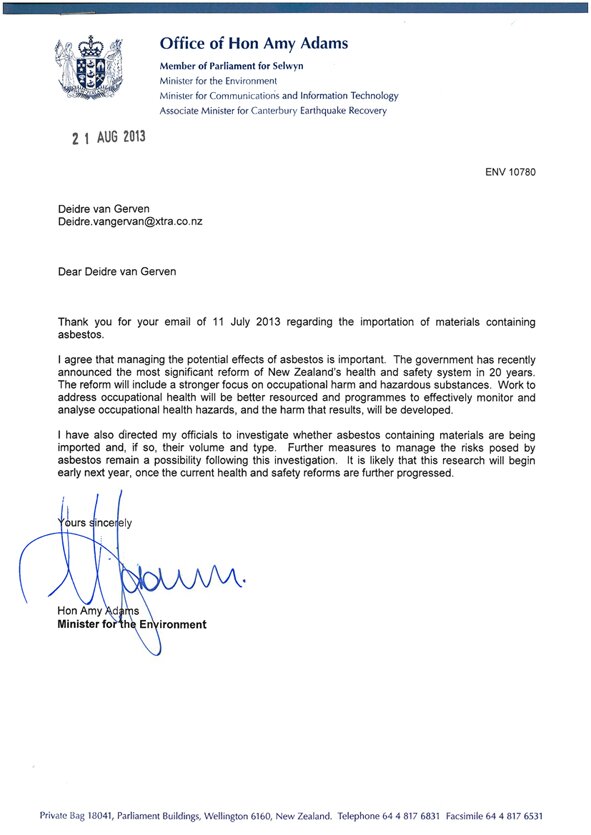
Tues Sept 3rd ,Subject: Please ban products containing asbestos
being imported into New Zealand
To Amy Adams
Minister of the Environment
Dear Amy.
Continuation of previous contact
made on the above subject.
-------------------------
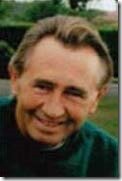
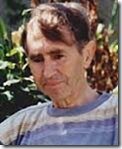
This was my husband Thomas.C vanGerven
just five months before being diagnosed with
pleural mesothelioma.
He was a healthy sixty year old man
looking forward to retiring and going
on a holiday to Australia to
see some of his family who live there. We had even booked the tickets
but had to keep changing the departure
times because Thom developed flu-like symptoms
and gradually deteriorated before
finally being diagnosed with pleural mesothelioma.
A cancer cause by asbestos.
And in Thom's case it wasn't the
raw asbestos but products containing asbestos
that killed him.
---------------
---------------
The same products that are allowed to
come into New Zealand because you
(for some completely unfathomable reason
believe they are safe to use)
You see, Thom was a specialized bricklayer
who repaired and built retorts and kilns
using fire cement and fire bricks
that contained asbestos.
Four and a half months later
this is my husband.
He had just been diagnosed.
Take a good look at Thom.
And then take another good look.
---------------------------
---------------------
Because this is what products containing
asbestos does to a person.
It kills them just like it killed Thom.
And many more will die in the future
because you have decided that it is safe
to bring these products into New Zealand.
How did you come to this conclusion
is what I would like to know.?
Did someone advise you they were safe
or was it just easier to ignore the facts.
I had already explained to you that
Australia has a complete ban on all products
containing asbestos from
entering their country.
They have no problem in seeing
the dangers of these products,
or finding replacements that
contain no asbestos.
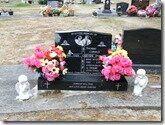
Instead of his holiday to Australia,
this is where Thom ended up.
Certainly not where he was
looking forward to going.
---------------------
------------------------------
So once again I am asking you to please
ban all products containing asbestos
from entering New Zealand.
------------------------
September 2013,
I made a forty page album up and sent it to Amy.
It showed the effects of asbestos on younger victims.
One of these was a young girl named Sophie
who was diagnosed with mesothelioma aged thirteen.
Aged 14year, one lung was removed and
she had chemotherapy, and radiotherapy.
The cancer spread to her spine and
she was paralysed from the neck down.
This beautiful young girl,
through no fault of her own
died from mesothelioma, aged eighteen
The stories in this album were about young people,
whose only contact with asbestos was
through their father's overalls,
school buildings.
Household of family members who worked with asbestos,
Exposed asbestos in the school gym,
helping his father fix their cars.
Asbestos in brake and clutch pads.
And the list just grows and grows
--------------------
--------------
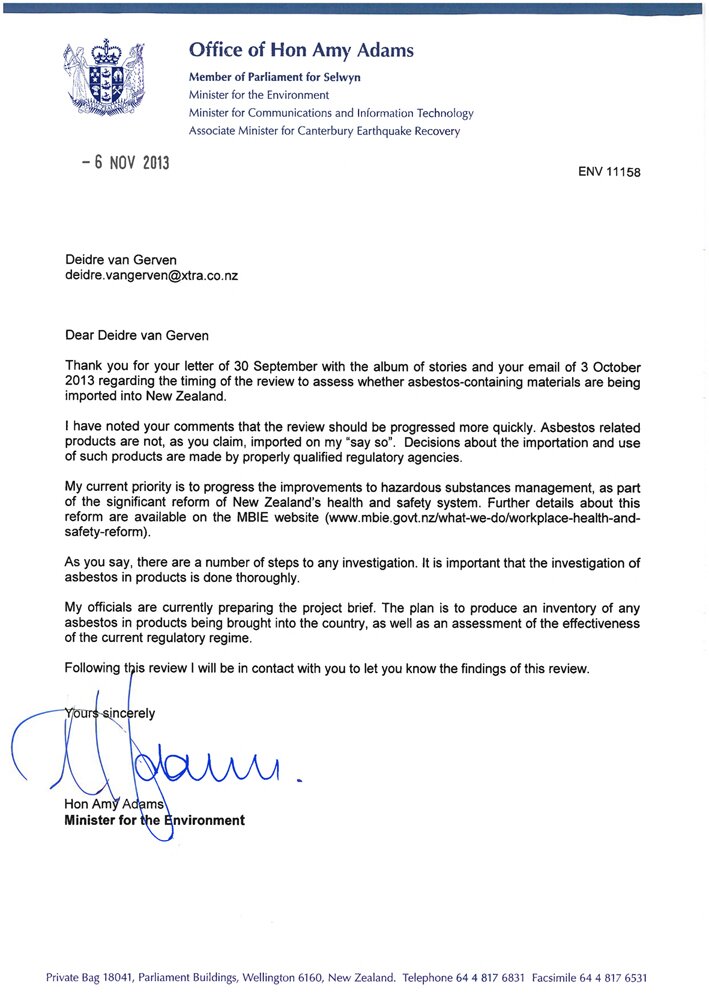
6th November 2013 Dear Amy,
I apologize for presuming these products are imported on your “say so”.
I just find it very hard to understand how anyone can
let these products come into NZ without
monitoring these products at the border.
I do know that the M B I E has asked someone
that if they suspect a product contains asbestos,
would they inform them so it can be banned.
Most people when dealing with many products,
are not going to send samples away
for each suspect to be tested.
Especially with a cost of $80 to $120.00 per sample.
Products containing asbestos are not listed
as a hazardous substance but as a
manufactured article and No HSNO approval
from ERMA is required .
So they would not be covered by any current regulatory regime.
And I have been looking at the new M B I E website
and as I said before these products are
not considered to be dangerous.
Regards from Deidre
These products are not even monitored at the
border due to difficulties in identifying these products.
(Amy Adams quote)
So if the government have difficulty in identifying
these products how on earth can anyone else identify them.
Unless you send a sample of each product
that you receive you are never going to know.
When I enquired at the two places that test these products in NZ
one of them told me that they have found asbestos in gaskets
and also in imported cement bonded fibrous board from Asia labelled
“Asbestos Free”) No other samples had been sent to be tested
but it goes to show that even if it says
asbestos free you cannot believe it.
Especially coming from an Asian country
that can see nothing wrong with asbestos.
So unless the government is going to pay for all products
to be tested then I believe that your
officials will not be able to give you a true figure
of these products.
There may be more but they can only test what is sent to them.
And remember, the only condition for these products to be imported
is that they need to have a label on them.
-----------------------
----------------
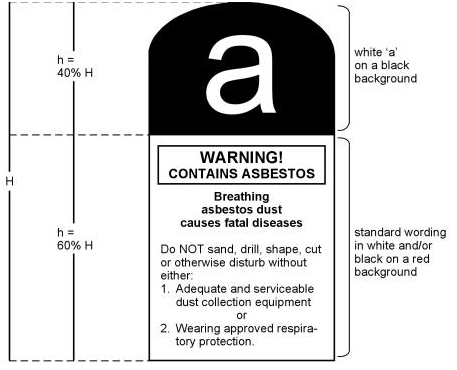
Part 4. Duties of manufacturers and suppliers
Labeling of products containing asbestos
Every manufacturer and supplier of products
containing asbestos must take all practicable steps
to ensure that products manufactured
or supplied on and after 1 April 1999
bear a label that is—
(a) in the form specified in Schedule 3; and
(b) affixed in a conspicuous place; and
(c) affixed firmly
-----------------
And this label tells you how to handle those products.
So in one breath you are being told that these products are safe
because they are a manufactured article and
not a substance and in the other breath
they are warning you of the consequences
of asbestos in these articles.
More Asbestos in NZ
--------------------
Asbestos Related Diseases
Specialists on Mesothelioma
Stories
New Stories
More Stories
Message For Navy Personnel
Poems And Verses
E-Mail Me
|