|
What is Asbestos
-----------------
(And what happens when we breathe it in.?)
Asbestos is a term used to describe naturally occurring hydrated fibrous
silicates of which there are 6 common varieties.
Three were used commercially in quantity
These are:
Amosite (brown asbestos)
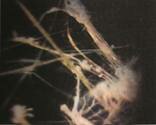
----------------------
Crocidolite (blue asbestos)
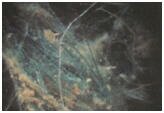
---------------------
Chrysotile (white asbestos)
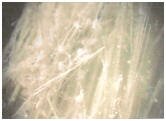
--------------------------
Asbestos fibres can remain unchanged in the body for years
---------------
The Uses of Asbestos
--------------------
The word asbestos was first used
by the Romans in the first century AD,
but by that stage the material had already been
in use for about 2000 years.
Archaeological evidence from Finland
has shown that a type of asbestos was used
to strengthen clay pots over 4000 years ago.
In the first century AD the Roman Writer Plutarch,
described a cloth woven from asbestos fibres
that could be cleansed by immersion in fire.
When the Venetian Explorer Marco Polo returned
from the East 1200 years later he too
described a fire suit he had seen.
It was not until the late nineteenth Century
that asbestos began to be used on a large scale
in the manufacture of many different items.
From the 1880's it was used increasingly
in the textile industry to produce incombustible products,
also gland packing and other linings for machinery.
---------------------
The different types of asbestos had some remarkable properties
with their resistance to heat,
friction and chemical decomposition
combined with their fibrous nature;
and as the industrial age
particularly the development of the automobile
gathered momentum early this century.
Asbestos began to be used in
an increasing range of applications.
World War One saw asbestos being used as
thermal insulation in Naval vessels and
by the 1920's the substance was firmly established
as a vital ingredient in the manufacture
of friction clutches and brake linings.
Coinciding with this increased use
was the discovery of large reserves of
white and blue asbestos in Russia,
Canada and South Africa.
Reserves of both were also found in Australia.
Asbestos became popular as the reinforcing material
in Cement products including wall claddings,
roofing material, pipes and guttering
and other building materials.
At the same time it was used more and more
in its raw state as an insulation
material in buildings,
around boilers and as a fire retardant
around steel work and as noise insulation.
-------------------
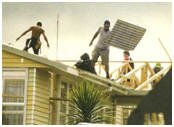
These photos show asbestos
roofing being removed from a
factory complex and a house
in the year 2005
Even then the workers were not using
protective clothing or respirators.
----------------------
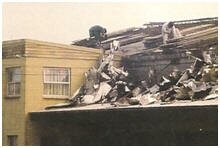
Photos kindly supplied by the late Ed Grootegoed
------------------
The post war period was the heyday
of asbestos use in New Zealand
and around the world.
Each of the three main types of asbestos were sprayed
and spread in what seemed to be an ever increasing
range of applications throughout industry,
as part of machinery components,
and, to a lesser extent in homes.
A United Kingdom report in the late 1970's
estimated that about 3000 manufactured products
contained asbestos in one form or another.
The same report said there were over 21,000 people
in the United Kingdom alone
employed in the manufacturing of products
which contained some degree of asbestos,
and about the same number employed in processes
which were subject to the asbestos regulations of the time
----------------------
Friable asbestos is the type which is capable
of being crumbled into fine particles by hand pressure.
Unless these fibres are completely encapsulated,
they tend to break down into a fine dust.
If you magnify a single fibre 1,000 times
it looks only slightly larger than a human hair.
Because of their size and shape,
these fibres can remain in the air
for long periods of time,
and can therefore be inhaled.
They can then easily penetrate the tissues
of the body and then remain there for many years.
A number of these fibres will be coughed up
because they are irritating,
but many of them will pass down the small airways
and alveoli (air sacs).
Fibres that remain in the body are
potential disease-causing agents.
Because of certain processes that occur in the body,
the development of various
asbestos related diseases may occur
Once these fibres are in the body they can move around.
This is probably because they are small and sharp.
They can go from the lungs into the pleura
and into the lymph nodes.
When these fibres are in your mucous
and sputum they can also be swallowed.
Some of these may then stick to the intestines and
then also move into the peritoneum.
(the lining of the abdomen).
--------------------
ASBESTOS EXPOSURE MAY OCCUR FROM THE FOLLOWING
TYPES OF EMPLOYMENT.
1) Plumber, fitter
2) Asbestos processors.
3) Electricians.
4) Waterside workers.
5) Asbestos sprayers.
6) Friction products.
7) Ship-building industry.
Insulation of boilers.
Steampipes.
Hot-water pipes.
Nuclear reactors in ships.
8) Building and construction industry.
Strengthening cement and plastics.
Insulations, fire-proofing.
Sound absorption.
Refactory bricklayers
(kilns, retorts etc.)
9) Automotive industry
Vehicle brake shoes.
Clutch pads.
10) Bakers and pastry-cooks.
11) Those people working or living in
the areas of asbestos mines.
12) Inhabitants from the Anatoli region of Turkey.
( Found in the soil)
13) Spouses and children of asbestos workers.
(Dust brought home on hair and clothing.)
14) Demolition workers and workers who
repair structures that contain asbestos.
15) Workers in refineries and power plants.
16) Fire fighters
17) Paper mills
18) Chemical plants
19) Steel mills
20) Aluminum plants
21) Welders
22) Labourers in any of the above employments
--------------------
PRODUCTS CONTAINING ASBESTOS
More than 5000 products contain or have contained
asbestos, some of which are listed below
-----------------------
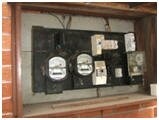 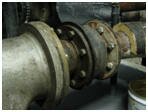
Electric backing board. Flange joint gasket to a water pipe
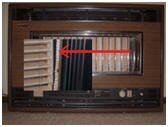 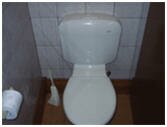
Asbestos was found here and in
the splash back panels in ensuite.
-------------------------
Asbestos cement sheeting and pipe products used
for water supply and sewage piping, roofing
and siding casings for electrical switchboards
and components, and residential and industrial
friction materials.
Friction products, such as clutch facings;
brake linings for automobiles, railroad cars,
and aeroplanes; friction materials.
Products containing asbestos paper, such as
table pads and heat-protective mats,
heat and electrical wire insulation,
industrial filters for beverages, small appliance
components, and underlying material for sheet flooring.
Asbestos textile products, such as components,
roofing materials, heat and fire resistant clothing
and fireproof draperies.
--------------------
 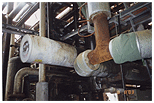 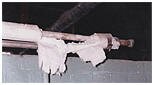
Lagging round pipes.
--------------------
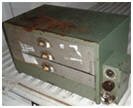 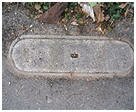 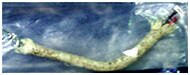
The pie warmer Pits Electric cable
Permission to use these photos came from Asbestos Info Australia
--------------------
Other products, including ceiling and floor tiling;
Gaskets and packings; paints, coatings and sealants;
caulking and patching tape; and plastic.
It has been used in a stipling compound
that has been used on the ceilings of 10,000s
of New Zealand homes.
"Thermal system insulation"
sprayed or trowelled on "surfacing material"
and vinyl or asphalt flooring is
particularly likely to contain asbestos.
Asbestos corrugated roofing.
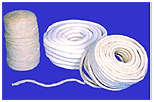
Asbestos rope
Feroda strips (which were cut and drilled for
rolling stock, brake riggings) at the railroad work shops.
---------------------
THIS PIECE ON ASBESTOS USE HAS ONLY JUST BEEN ADDED
March 2009)
Subject: Asbestos use as told by a paint salesman, in the USA.
ASBESTOS MUST BE BANNED
IT IS STILL BEING USED,
even imported into this country.....
We met a gentleman who was a Hospice volunteer,
r who retired after being a salesman
for (???? Paint) in Baltimore,
Milwaukee and Wisconsin.
He said the painting contractors would buy asbestos
(don't know what the configuration was, sheets or what).
Anyhow, they would cut them into "shorts"
(not the kind we wear!)
that were about inches long and add them
to a 5 gal container of paint and mix them in.
They would soak it overnight for the asbestos to break down.
Next day they'd mix with another 5 gal of paint.
This particular outfit worked on school construction
back in the 1950s, 1960s and 1970s.
The asbestos laden paint would be rolled on
as a block filler over the blocks
and this would fill in the "cracks"
between blocks and then a final paint applied over it!
He said a lot of the guys who were painters
were dying at very young ages.
50 to 55 years old they were.
Don't we know that!
If they used it on school buildings,
they used it on many other buildings!
YOU CAN BET YOUR BOTTOM DOLLAR WE HAVE WARNED,
EVERYBODY ABOUT ASBESTOS EXPOSURE
WHEREVER WE WERE DURING (M's) JOURNEY
FOLLOWING HIS FALL AND BREAKING HIS HIP.
We asked that they support a total ban
of asbestos and they were amazed to learn
it is still being used....!
Perhaps that's one of the "gems"
God is using for this "diamond in the rough" time
(M's) going through...!
Not one crumb of our life is ever wasted
--------------------------
Asbestos In New Zealand
Asbestos Related Diseases
Specialists in Mesothelioma
Stories
New Stories
More Stories
Message For Navy Personnel
Poems And Verses
E-Mail Me
|